
Saddle height calculator
Enter your cycling inseam to estimate saddle height with the LeMond method, measured from the center of the bottom bracket to the top of the saddle.
LeMond method
73.3 cm
How to measure your inseam
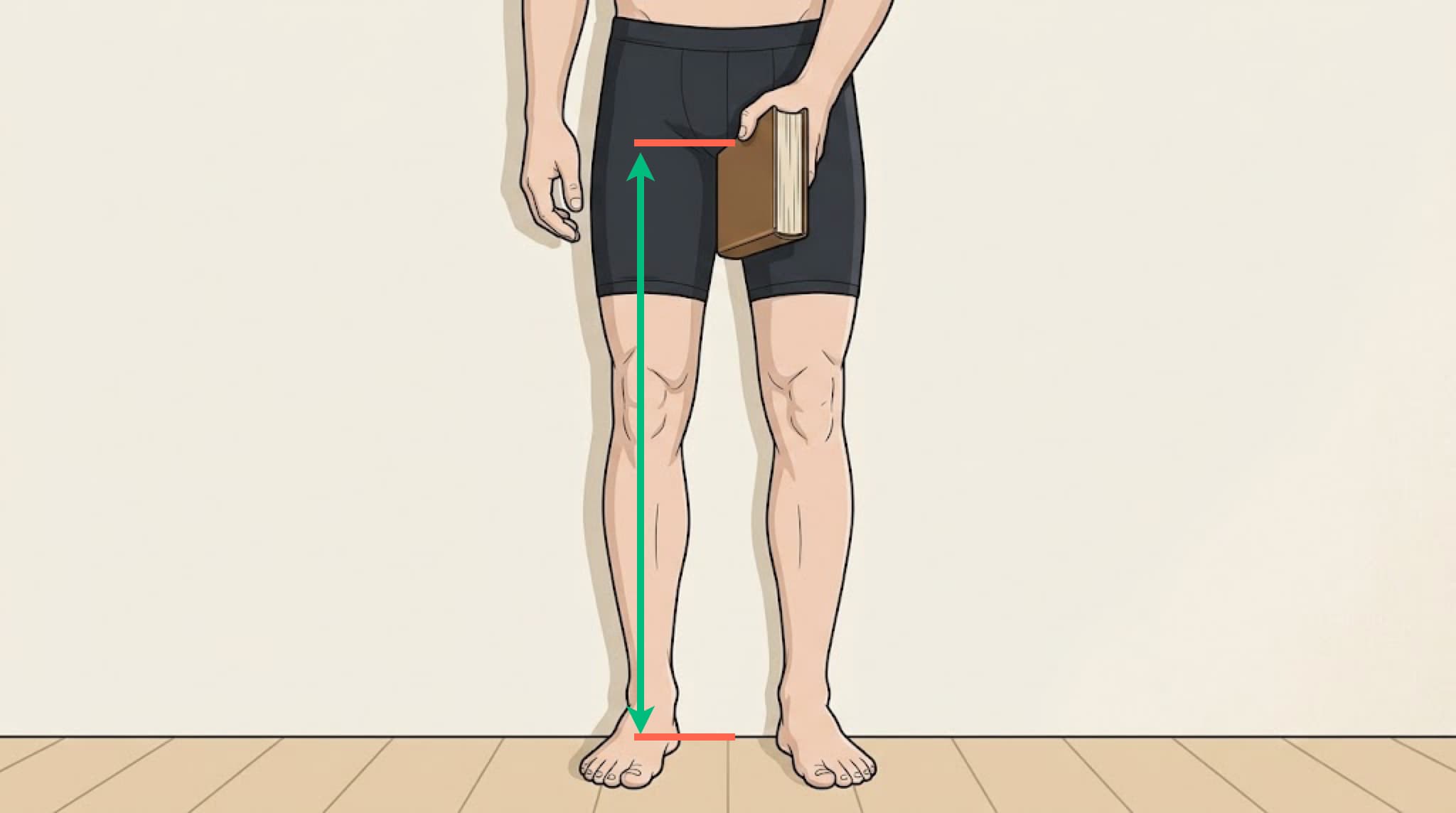
Stand barefoot against a wall with your feet about 15 cm apart. Put a hardcover book between your legs and pull it up firmly, like a saddle. Mark the top edge of the book on the wall and measure from the floor to the mark. That is your cycling inseam, and it is usually 2–4 cm longer than your trouser inseam.
How this calculator works
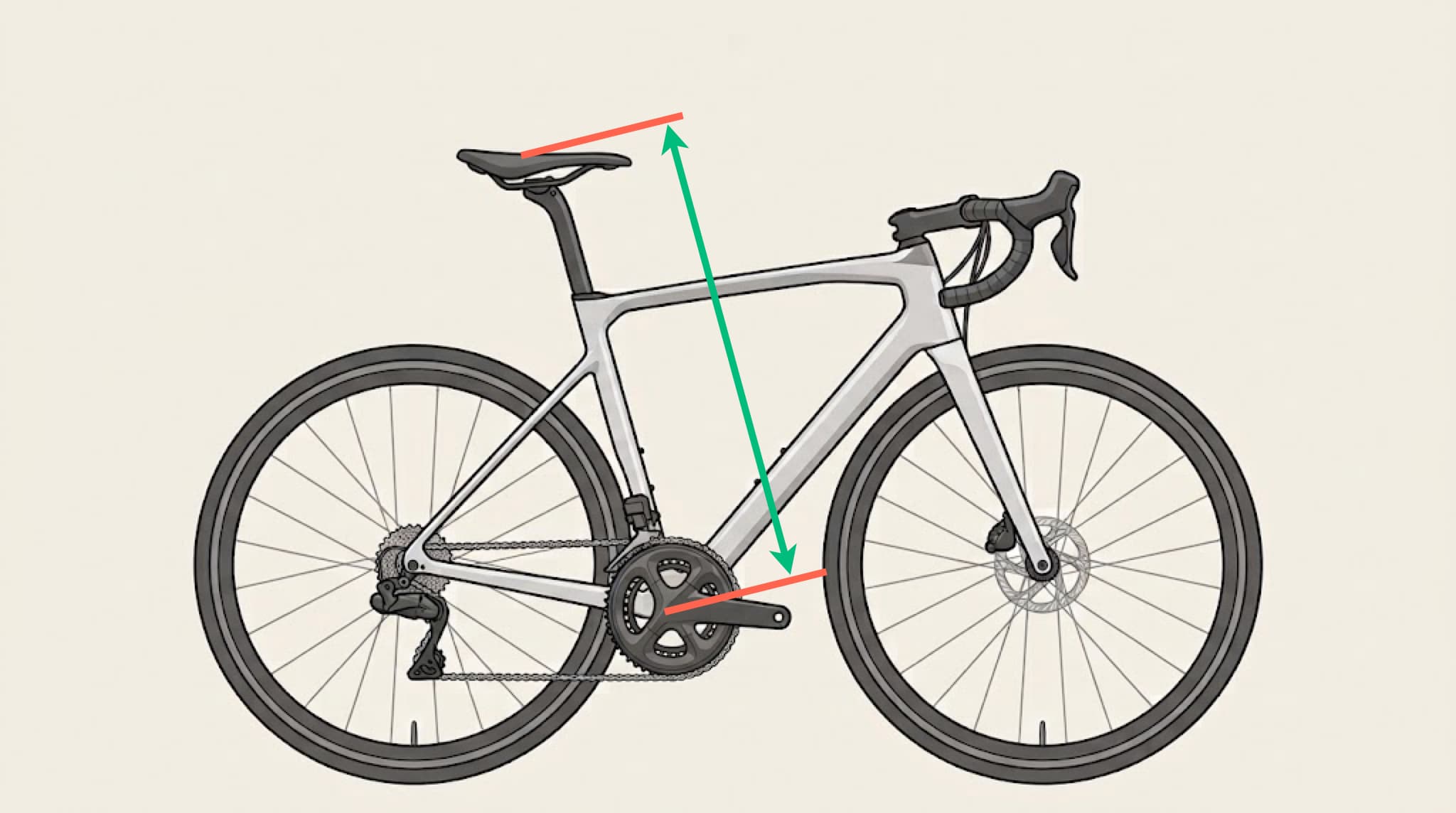
The LeMond method estimates saddle height from the center of the bottom bracket to the top of the saddle, along the seat tube, by multiplying inseam by 0.883. Use it as your starting point, then fine-tune from there.
Frequently asked questions
- How do I measure my inseam for saddle height?
- Stand barefoot against a wall with your feet about 15 cm apart. Put a hardcover book between your legs and pull it up firmly, like a saddle. Mark the top edge of the book on the wall and measure from the floor to the mark. That is your cycling inseam, and it is usually 2–4 cm longer than your trouser inseam.
- Where does the LeMond formula come from?
- The LeMond method (inseam × 0.883) comes from Greg LeMond's training notes and estimates saddle height from the center of the bottom bracket to the top of the saddle, measured along the seat tube.
- Where exactly do I measure saddle height on the bike?
- Measure in a straight line from the center of the bottom bracket (the axle the cranks turn on) to the top of the saddle, with the crank arm in line with the seat tube. This is different from measuring straight up from the floor, which also depends on tyre size and crank length.
- Is a formula-based saddle height good enough?
- It is a solid starting point, not a final answer. Formulas only use inseam, but knee angle at the bottom of the pedal stroke also depends on cleat position, crank length and pelvis flexibility. Two riders with the same inseam can need different saddle heights. Use the formula to get close, then fine-tune by feel or against a measured knee angle.
- What happens if my saddle is too high or too low?
- Too high, and your hips rock side to side to reach the pedal at the bottom of the stroke, which can strain the lower back and the back of the knee. Too low, and the knee stays too bent through the stroke, which loads the front of the knee and wastes power. Both extremes show up as a knee angle outside the healthy range at 6 o'clock.
- Does saddle height alone give me a full bike fit?
- No — it is one number out of several that make up a position: saddle height, saddle fore/aft, reach and back angle all interact. Pedalyze measures your actual knee, hip, torso and elbow angles from two photos of you on the bike, and checks them against reference ranges rather than a single formula.
Related guides
- Knee angle in bike fitting — The 25–35° knee flexion rule at the bottom of the pedal stroke: what it means, how to measure it from a photo, and how to adjust your saddle height.
- How to take bike fit photos — The photo is the measurement: camera height, 90° side-on framing, crank at 6 and 3 o'clock, clothing and lighting — everything that makes fit angles accurate.
Other tools
- Saddle setback calculator — See how far behind the bottom bracket your saddle sits, and how that compares with the range road and time-trial riders use.
- Bike frame size calculator — Get your frame size from your height and cycling inseam, for road, gravel, mountain and hybrid bikes, with a size chart for each.
Check this with a photo
A formula gets you close. Pedalyze measures your actual knee angle from two photos of you on the bike and tells you exactly how much to move your saddle.